Journey – 2012
Navigating this
South American
Diary:


Diary of a Journey to South America – Part Five
Adventure Tourism
Tuesday, January 8, 2013
– in Buenos Aires 24
There are at least two types of tourism: one that I call “Cocoon” tourism, and one that I call “Adventure” tourism.
An ocean cruise is a prime example of “Cocoon” tourism. The traveller is comfortable, safe, and protected. Going ashore, you can visit all the significant sites, but the cruise line provides you with a guide who speaks your language, and will even arrange for some of the local people to feed you and entertain you with their cultural customs. It is as if you are in a plexiglass container, where you can see everything but nothing can harm you. You return to the ship never once having left its protective embrace.
I like Cocoon tourism. I get to see all sorts of fascinating places, and the cruise line makes sure that I do not have a worry in the world.
By contrast, the essential ingredient of “Adventure” tourism is that all protective barriers between you and the place you are visiting have been removed. There is no guide; there are no guarantees of safety; you’re on your own.
I met a man on board our cruise ship who planned – once the cruise was done – to bicycle across the Andes mountains, from Buenos Aires to Chile. That is Adventure tourism in the extreme. But although living on our own in Buenos Aires, in an apartment that we found for ourselves, may be a lot tamer than such cycling, it is still genuine Adventure tourism, because we have no safety net. What becomes of us is our responsibility and no one else’s.
I told you all this because I find that I’ve learned something about myself during this stay in Buenos Aires. What I have learned is that, as nice as Cocoon tourism can be, I really like a little bit of Adventure tourism now and again. These few days on our own in this city have just been enormous fun for both of us.
Yes, in some ways, we are still plain old garden variety tourists. We’ve gone on tours and eaten in restaurants and we’ve visited places that every tourist ought to see. But we're doing it on our own, and have no safety net, and are having the time of our lives.
I can’t describe it all here, but let me tell you about two of the neighbourhoods in Buenos Aires that should be on everyone’s check list: La Recoleta, and La Boca:
La Recoleta
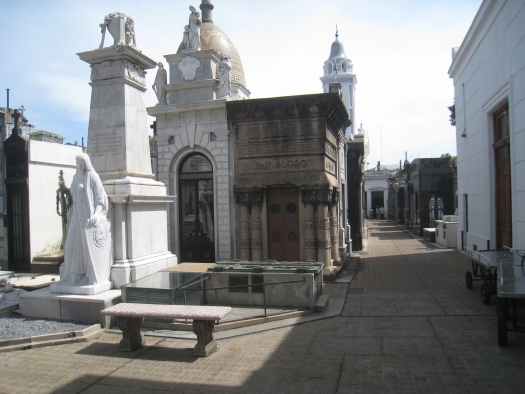
Mausoleums in La Recoleta Cemetery
Beautifully designed stone houses for the dead
We’re living in La Recoleta, actually. It’s a beautiful neighbourhood of condos and upscale boutiques, delightfully safe to walk in... and it is named for a cemetery!
Long ago the citizens of Buenos Aires decided that the best way to bury loved ones was for each family to build a small mausoleum. In this mausoleum, the bodies of successive generations of the family could be placed. A cemetery – La Recoleta – thus grew up, consisting of hundreds and hundreds of such structures: each one a unique stone house, with windows and a door, and stairs going underground to vaults where bodies can be placed. The place is astonishing, beautiful, and fascinating.
Many of the most famous people of Argentina are buried in La Recoleta. The one known to almost the entire world is Eva Peron, the storied Argentine public figure whose short life was dramatized by Tim Rice and Andrew Lloyd Weber in the musical, “Evita.” Her embalmed body is in a mausoleum belonging to her father’s family: the Duarte family. Flowers are continually left at the door of this particular home of the dead in La Recoleta.
Our apartment-hotel is not far from the cemetery, and we’ve been able to walk to it quite easily. Not only that, the cemetery is such an important tourist spot that open-topped tour busses regularly stop there, so Heather and I took a tour of the city and were deposited back near our apartment without any difficulty.
La Boca
This barrio, or neighbourhood of Buenos Aires is known for its colourful houses, vivid public art, left-wing political movements... and the Boca Juniors, a football 25 team of international renown. It is fun to walk there, simply because of the bright colour, and the occasional display of tango dancing, or gauchos doing tricks with bolas, not to mention the innumerable artist and handicraft stalls.

The colours, red and white, are forbidden!

One of the greatest triumphs of “Adventure” touring is finding your way around, especially in a city where you do not speak the language. The simplest method – and we used it often – is the taxi. Write down the address that you want to go to, show it to the taxi driver, and unless he’s going to rob you blind and leave you in a ditch, you’re there. You’re a little poorer, perhaps, but it’s done. Public transit is a much greater challenge.
If possible, I like to go to church on a Sunday wherever I am. If there is no Anglican church, I’ll find something.
It turns out that here in Buenos Aires there is a perfectly lovely Anglican church: la Catedral Anglicana de San Juan Bautista (Cathedral of St. John the Baptist). I found it on the Internet. Their website says, “Bilingual Service (English/Spanish – Spanish/English)” on Sundays at 10:00 AM. So I carefully wrote down the Spanish version of the address – for the taxi driver – and on Sunday morning, allowing ourselves plenty of time, we went out and hailed a cab.
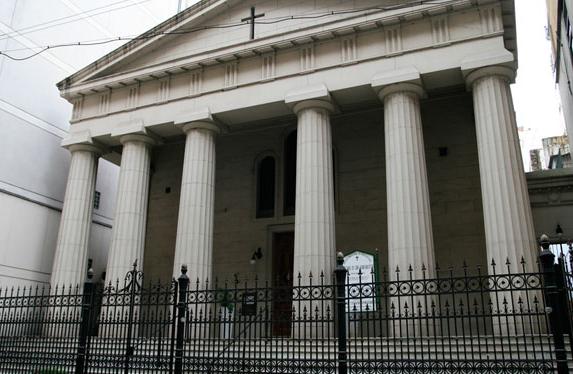
In due course we were dropped off at the church. Actually, not quite at the church, because it turned out that the street we wanted has been completely dug up; it’s being converted to pedestrian-only. So the cab left us at the nearest intersection, and we had to look around a bit before we found the church itself, nestled among downtown financial buildings, and hidden behind a tall fence of ornamental ironwork.
But once inside, we found ourselves definitely in an Anglican church, and we were handed a bilingual Bible, a bilingual service book, and a bilingual pew leaflet. We must have been fairly conspicuous, because we had hardly taken our seats before the Rector himself came to welcome us. He’s a Scot, who has married an Argentine woman, and has made his home in this country. When the service began, he spoke a great deal of Spanish. The Gospel was read twice: once in each language. This particular week, the sermon was in English, but a translation of it was handed out, so that Spanish-speakers could more readily follow what was said. I later learned that next Sunday the situation will reverse: the sermon will be given in Spanish, and an English translation of it will be distributed in the pews.
The actual Eucharist portion of the service has such a familiar structure that, for me, even when things were in Spanish I always knew what was going on, and felt quite at home. It was good to be there.
Afterwards we went to the parish coffee hour, and met many interesting people – Philippe and Nancy, for example. Philippe is an American Acadian, who teaches English in Buenos Aires, and his Argentine wife Nancy is a science writer/editor. As it turned out, they live in the La Recoleta district, not far from us. So, when it was time to leave I asked them if they would mind driving us back to our apartment hotel.
“We don’t have a car,” they said, “we’re travelling by subway.”
“Really? That could be even better!” said I. “Do you think you could help us get home by subway?”
“We’d be glad to,” they replied.
And so it was.
The nearest subway station was a couple of blocks away from the church, so this young couple transformed themselves into tour guides, walking along the downtown streets and pointing out places of interest to their two Canadian visitors.
Suddenly I recognized where we were. We had come out into the square at the heart of Buenos Aires, where there’s a park, several government buildings, the famous Pink Palace (seen in movies about Eva Peron, where Eva stands on a balcony and addresses huge crowds), and the Roman Catholic cathedral.
“C’mon!” said Philippe, “I want you to see this!” And he disappeared into the cathedral.
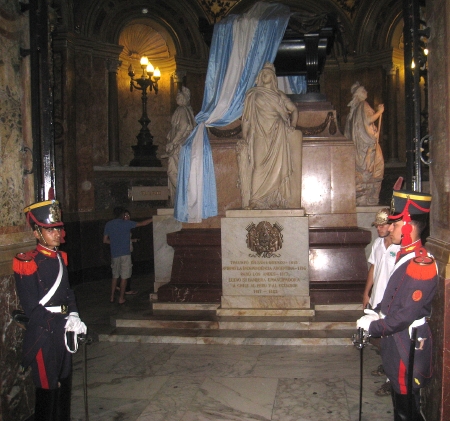
Tomb of José de San Martin
Liberator of southern South America, 1810-1820
There was a Mass underway, and hundreds of people were in attendance, but nonetheless Philippe trotted up a side aisle, with Heather, Nancy and me following as quickly as we could. On the way, I noticed a number of tourists with cameras wandering about, so I felt a little better about coming in during Sunday worship.
Our destination was an annex – an enormous room with a ceremonial armed guard at the entrance. Inside was a coffin, high up, supported by the grandest of carvings and statuary. A plaque explained that this is the sarcophagus of José de San Martin, Liberator of southern South America.
Apparently San Martin led military forces in 1810-1820 that achieved the independence of much of South America from Spain, and in many ways he is seen as the founding father of Argentina. I am certain that, to an Argentine citizen, visiting San Martin’s tomb would generate awe and reverence comparable to what an American might feel upon visiting George Washington’s tomb in Virginia. It is a very imposing place indeed, and I’m glad Philippe took us there.
On we went to the subway!
Buenos Aires is a very beautiful and scrupulously clean city, but its subway is not. Grafitti, broken tiles, garbage and litter are everywhere. But the trains run, and we were safely conveyed to a stop near our hotel.
Okay, I probably shouldn’t say it, but as you may have noticed in the above, churchgoing turned out to be a surefire way to accomplish one of the most basic goals of all Adventure tourism: connecting with local people. In a house of worship – no matter what religion – local people are proceeding with their normal lives. They welcome you because you share their religious values, and they are often willing to trust you and show you something of their world. And, let’s face it, most participants in any of the world’s great religions are decent human beings. They are very unlikely to rob you or leave you bleeding in a ditch. They are safe.
Of course I prefer Christianity to get adherents on its own merits and not because it is a means to an end; but there is no denying that participating in worship is one of the safest and most pleasant ways for an Adventure tourist to ‘go local.’ I suppose, though, that nobody reading this is going to start attending worship just so that they can have a better experience the next time they travel, so it’s probably all right to point out the somewhat obvious truth about our trip to church last Sunday: it was our best day for just being with the people of Buenos Aires.
Another generalization: Buenos Aires is a very very beautiful city. It strikes me that throughout its history, whenever Argentines needed to build something, or furnish something, they invariably chose the best architects and designers of their generation. Are you looking at a building constructed in 1850? It was designed by the finest architects of that era. And this one, made in 2008? Same thing. Modern or centuries old, everything in Buenos Aires speaks of the best in design.
Which leads me to a third generalization that isn’t so complimentary. I’m thinking particularly of Argentina’s conflict with Britain over the Falkland Islands.
In Buenos Aires we have stepped into the opposing side of that conflict. Once, in a tour bus (I can’t figure out exactly where), we passed an office building whose title was “Office of the Malvenas.” Argentines do not refer to those islands in the South Atlantic as “Falklands,” they call them the “Malvenas.” The office that we passed is clearly and obviously devoted to Argentina’s sense of entitlement to those islands. Apparently throughout Argentina and at her various border stations you can see signs that say, Las Malvinas son Argentinas (“The Malvinas are Argentine!”). Argentines claim that sovereignty over the islands was ceded to them by Spain when they achieved independence in 1817, and they have consistently and loudly made this claim ever since!
But nobody who lives on those islands wants anything to do with Argentina, and as far as I know, never has. In fact Argentines haven’t actually lived more than a year or two in the place – ever – while British people have lived there continuously since at least 1840. 27
It seems to me that – for Argentines – the issue is a matter of “face” – appearances; the look of things. And since they “lost” that war with Britain in 1982, it’s probably more important than ever to them that they “save face” on the matter. So they continue to assert sovereignty, despite the manifest hostility of the islands’ inhabitants.
My foolish generalization thus centres around Argentina and appearances. Not only are Buenos Aires’ buildings stunning, I’ve never seen so many beautiful women in one place in all my life! I think, therefore that it is hugely important to Argentines to be beautiful, and to appear to be sovereign and glorious in all matters. Their favourite human being is Eva Peron – a stunning beauty, who triumphed over lowly and socially-outcast beginnings. She is a symbol for them, and a symbol of their country, having achieved almost the status of a saint. And – is this significant? – they have a museum devoted to her clothing!
Clothing... appearance... face. A beautiful city for tourists to see, but underneath, on the subway, squalor. A cemetery at La Recoleta of beautiful stone houses... with only bones and ashes inside.
You can probably forget most of the above generalizations, but I am convinced that “face” is 90% of the Falklands conflict. 28
Last generalization: the people of Buenos Aires get high marks for their friendliness to strangers. As we walked about the city these past few days, carrying and sometimes consulting maps – there were no less than three occasions when people stopped us to say, “Can I help you? Do you need assistance in finding something?” The people who did this were very ordinary, well-dressed regular folks. The first was an older lady, who approached us on Sunday as we emerged from the subway. She was on her way to attend Mass, and her English was minimal, but she clearly wanted to help us as we stood there figuring out the direction that we were to go.
The second, only a few minutes later, was a 50-plus male in pressed shorts with absolutely no English at all, who walked along beside us chattering like a magpie and smiling; merely talking more loudly when we said “Gracia! Non-comprendo! Gracia!” As he turned to go to his destination, he waved goodbye cheerfully (we, however, felt a certain amount of relief). The irony was that we knew exactly where we were going; it was just that the map was conspicuously in my hand, and both those people obviously and sincerely wanted to help.
The third time we were spontaneously assisted was the most important one: a 40-plus matron with flawless English saved us from accidentally traversing a socially-unpleasant neighbourhood yesterday, when we got off a bus at the wrong stop. That one was all my fault, by the way. The four travellers – Werner, Mary, Heather and Tony – had gone down to La Boca and were “going local” by taking public transport back to our apartment. We got on the correct bus, and recognized the route it was taking, but then I got confused when the bus went around a monument and seemed to be heading back in the direction from which it had come. This was simply because I had misunderstood the map at that point, but I became alarmed, and hurried my wife and friends off the bus at the first available stop. It turned out that we were only a few blocks short of where we should have disembarked anyway, and, with the kind lady’s help, we got pointed in the correct direction, and reached our apartment without further incident.
There is one aspect of our type of Adventure tourism that is genuinely extreme: we are in a city that is 11,000 km. from where we live, and we have no ticket home.
Regular readers of my adventures know that since our daughter Rachael became an Air Canada flight attendant, we usually travel by flying “standby.” Rachael sets it up for us. She logs on to a website and finds out which flight has a few empty seats on it, then she books us on that flight in our capacity as her parents. The cost of such tickets is extremely low, but stress levels are high if there are no seats available on the day that we plan to travel!
And that is exactly what has happened to us here in Argentina. There are only a few Air Canada flights out of Buenos Aires each week, and when Rachael checked they are all full!
They get emptier next week, but our occupancy of this beautiful apartment ends tomorrow and we’ll have to find somewhere else to stay, and even then there’s no guarantee that we will be able to fly out. Besides, Heather has a meeting in Toronto on Saturday that she’s committed to attend...
So we are certainly having extreme “Adventure” tourism now, stranded in a city that is so impossibly far from home!
After a couple of hours, Rachael came up with a complex plan. She bought tickets on a regional carrier (not Air Canada), that would take us from Buenos Aires to Santiago, Chile. These tickets are also “standby,” but she says that there are seats available, provided that we get ourselves to the airport tomorrow by 5:30 AM. Then, once we get to Santiago – if we get to Santiago – there are more seats on more Air Canada planes heading for Toronto. We might make it to Toronto in time for Heather’s meetings. Then again we might get stranded in Santiago!
Determined that this complex procedure is the plan that we ought to follow, our daughter has sent us, via Fed Ex “Overnight” courier service, that pair of Buenos Aires-Santiago tickets. There is no electronic ticketing available. We must have paper tickets in our hands when we get to the airport. The Fed Ex package is supposed to arrive at our hotel this evening.
But... and this is the really scary part: I checked the Fed Ex tracking number today, and the tickets aren’t going to get here until Thursday – a mere twenty-four hours too late! So much for “overnight” courier service!
Can you say, “S-T-R-E-S-S” ???
Luckily, when I found out about the delayed courier, Rachael happened to be at home and active on Skype, and so we were able to discuss the situation immediately.
And, while I was talking to her, I also went online to see if there were any full-fare plane tickets available from Buenos Aires to Toronto. I have checked often, from the first moment that Rachael said she might have trouble getting us standby seats, and yes, there are seats available, 29 but most of them would cost us upwards of $5,000 for two tickets... which is pretty hefty. Rachael’s complex method is going to cost us between $1,100 and $1,800, depending upon how many nights we’re forced to stay in hotels... so the difference in cost is considerable and I hesitate to, as it were, throw $3,300 or more to the winds.
But just now, when I clicked on the same site for last minute flight bargains, like magic, or a miracle, or an answer to prayer, 30 I saw that two seats had just come available on TACA airlines, flying from Buenos Aires right through to Toronto, for a total of $2,000 – airport fees, meals, and taxes included.
Rachael said, “Take it! Go! You would never have gotten better on a seat sale 3 months ago! And TACA is a great airline!” So I’ve purchased them, and if everything works properly, we shall be returning to Canada on the day we had always planned.
So our time in Buenos Aires comes to an end with a bit of a heart-racing scare, in the true spirit of Adventure tourism, but we now have confirmed seats on a good airline, and by midnight tomorrow, we’ll be in Canada again.
Some touristy notes about Buenos Aires:
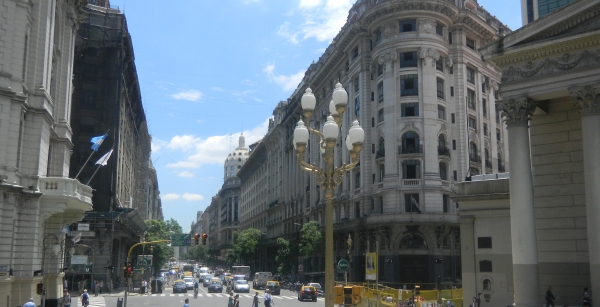
Avenida Pres. Roque Sáenz Peña, Buenos Aires Buenos Aires is a truly beautiful city photo: Werner Schulz |
Buenos Aires really is a beautiful city, and in the main downtown area, things are very very clean. On the weekend that we were there, we saw hoards of people in all the public parks, just being outdoors and enjoying themselves, and there were arts and handicraft markets simply everywhere. But, with all the potential that these things have for litter and mess, by Monday morning everything was swept up and tidy.
Such beauty and cleanliness may not be the case in districts that are less-frequented by tourists. There was that subway, for example, and, as we took the cab out to the airport we passed some very dreary-looking places with wall-to-wall graffitti, and garbage strewn about.
Still there is no denying that where we lived in La Recoleta, and all through the downtown, we walked and looked and ate and explored, and were completely safe, and perpetually astonished by the all-pervasive beauty. 31
Restaurants: although staying in a completely different district from our friends, we met them most days and explored together. We ate out with them at pricey, touristy spots, and at little, local, out-of-the-way eateries (I infinitely prefer the latter).
The best place to find touristy restaurants is on the restored waterfront (it’s a lovely place for a walk even if you don’t choose to go to any of the restaurants). And, wherever you eat in Buenos Aires, expect the best beef in the world. Other types of food? For the most part, bland and tasteless, says Heather. Argentines are not given to spicy dishes.
English: it’s NOT widespread. Are you good at Spanish? Great. But be aware that the dialect spoken in Argentina is different from other Spanish. For example, both a double-“l” and a “y” – depending on placement in the word, are pronounced with a soft “sh.” Take the place name, “Callao:” an Englishman says “Call-ay-oh,” a Chilean says “Kai-ah-oh” and a Argentine says “Cash-ah-oh.” Very confusing even if you do know a bit of Spanish!
We, on the other hand, have no Spanish whatsoever. Yet we got by. As I’ve already mentioned, for taking taxis (there are millions of them), I just wrote down the address of where we wanted to go, and showed it to the driver. In a grocery store I used a dictionary, which gave me the words for the specific items that I needed (living as we were in an apartment hotel, we bought groceries and ate breakfast, and sometimes lunch, at home). The rest of the time was all pointing and gesticulation.
Money: US$ is sometimes accepted, but it is easier and cheaper to get Argentine Pesos and spend them. Only thing: trade back your pesos (to U.S.$ if not to your own currency) before you leave the country. We turned up in Canada with 200 pesos in hand, and not a lot of hope that banks will trade them in for us; a currency exchange wicket in Miami certainly wouldn’t touch them.
Getting around: one of the most curious things that we noted while in Buenos Aires was that – to our way of thinking – published maps of the city were upside down! That is, where we are accustomed to seeing North at the top of a map, in Buenos Aires North was printed at the bottom of the page, and South at the top. It turns out that this is not entirely unique to Argentina. While having North on top is a convention dating back to Ptolemy, it is merely a convention, and a number of people in recent decades have experimented with deliberately viewing the world the opposite way around. See a Wikipedia article on the topic. It seems that in Buenos Aires at least, the concept has moved from experiment to actual common practice.
The phenomenon affected me personally. Normally very good at orienteering, in Buenos Aires I was constantly getting myself turned around, thinking we should turn right at the next corner rather than left. Trying to find where I was on one of those “upside-down” Buenos Aires maps only made matters worse. Nothing bad happened as a result – we always found our way – so I mostly found the phenomenon fascinating.
Next: Last Legs
FOOTNOTES:
24 I cannot tell a lie: at the root of this entry are diary notes that I made in Buenos Aires on January 8th, but the bulk of this entry was written after I got home and had begun to take a broader and more comprehensive view of the whole journey.
Click here to get back to the narrative.
25 We’re talking about the game that North Americans call “Soccer,” of course. This type of football is wildly popular in Argentina, and some of the world’s greatest players come from here.
Click here to get back to the narrative.
26 I don’t know why, but “Boca Junior” and “River Plate” are the actual names of the football clubs. I have not translated Argentine names into English for this blog.
Click here to get back to the narrative.
27 No trace of indigenous occupation has been found on the islands. The only people ever to try living there have been of British and European descent.
Click here to get back to the narrative.
28 Some observers suggest that tension is mounting once more over the Falklands because oil is now known to be just offshore of the islands. Oil complicates matters, without a doubt. However, long before there was any thought of oil development Argentines have steadily asserted their sovereignty over the place. Argentina invaded in 1982 because the then president was seeking re-election and sought to gain votes by the invasion. The current president’s popularity has been waning since her election to a second term in 2011, and it is thought that she has a similar motive for turning up the heat on this age-old loss of national “face.”
Click here to get back to the narrative.
29 Rachael had said that there are no standby seats on flights this week. However, some occupied seats are probably carrying Air Canada employees at a deep discount. If we were to pay full fare for a ticket, two of those employees would get ‘bumped,’ which is a pity, but I’m not in a mood to trifle. As well, several seats are available on other carriers, so we’re not exactly trapped in Buenos Aires. The only trouble is that, up to now, all those available seats cost a lot of money!
Click here to get back to the narrative.
30 Indeed it really is an answer to prayer, for you better believe that I’ve been praying up a storm since learning two days ago how uncertain our departure from Buenos Aires might be.
Click here to get back to the narrative.
31 An article in the Globe & Mail, published January 21, 2013, underscores the architectural beauty of the city. It’s entitled, “In Buenos Aires the Buildings Make me Weep.” Click here to see it.
Click here to get back to the narrative.