Journey – 2012
Navigating this
South American
Diary:


Diary of a Journey to South America – Part Two
Whales!
Saturday, December 8, 2012
– leaving Cabo san Lucas, Mexico
Okay, let’s get the best part stated right at the outset: I saw two whales up close today. It was part of the snorkelling expedition, during which we were taken by high-speed Zodiac to two different reefs. On the way back to the ship, the young men in charge of our craft deliberately went out far from shore where, they said, whales are often to be found, and lo! two humpbacks came up, vented a couple of times, and dived. What a treat! And I caught it on video, too!
Snorkelling – the purpose of this expedition was grand. On the first reef we encountered huge schools of tropical fish that came up all around us (I think that one of our guides was giving them food). On the second, we were led, swimming, along an extensive reef formation. Although there were not so many fish on that reef, the underwater topography was quite interesting. If the sea had been any rougher, though, our journey might have been very dangerous because there were palpable currents that could have thrown us against the jagged rocks. But today, although the currents were noticeable and I worked hard keeping on course, nothing untoward happened... except: I was well and truly tired by the time we got back to the Zodiac.
The “we” in this case was the ten or fifteen Zodiac passengers plus the two guides, or more immediately Mary Schulz and me. Neither Heather nor Werner had any appetite for high-speed watercraft and energetic exercise. Werner went somewhere on a catamaran, and Heather went into Cabo San Lucas and shopped.
I was, in some ways, Mary Schulz’ mentor on this expedition. She has had a lifetime phobia of swimming among fish, and had no idea how to snorkel. She wanted to overcome this deep-seated fear, and so I offered to teach her the use of mask and snorkel, and to stay beside her to “protect” her from unwanted fish contact. When we first dropped over the side of the Zodiac, she was almost hyperventilating with anxiety, but slowly she got things figured out, and by the end of the trip she was absolutely exhilarated, both because she had conquered her fears and because she found the underwater world to be beautiful and enchanting.
And then, on the way back to the ship we saw the whales.
Sunday, December 9, 2012
at sea, off the coast of Mexico
There are Christmas trees in the lobbies and dining rooms of this ship; some of the guests have put Christmas ornaments on the doors to their staterooms; but none of this communicates “Christmas” either to Heather or to me. It seems incongruous.
In the same vein, today is Sunday – the Second Sunday of Advent – and an “Interdenominational” church service was offered this morning. I went, and found that it was led by a Roman Catholic priest, who preached a sermon about the meaning of Advent. Had I preached, I would have mentioned several of the same things – it was a completely orthodox sermon – but again, it felt incongruous to be reflecting upon Advent in this tropical cruise!
And it is now definitely tropical! The sun blazes and the heat is intense. I have a rather bad sunburn, in fact. Got it yesterday, snorkeling, before we had even entered truly tropical waters.

Monday, December 10, 2012
at sea, off the coast of Mexico
Did you know that an earthquake of Magnitude 2 or greater – strong enough to be felt by nearby humans – happens somewhere in the world every thirty seconds? I learned this from a lecture that was given this morning in the ship’s theatre. Apparently our route takes us along a portion of the so-called “ring of fire” – a circle of intense seismic activity that borders much of the Pacific Ocean – so the cruise line has employed a retired geophysicist to explain earthquakes and volcanoes that are such a feature of this part of the world. From his lecture I also learned that an earthquake anywhere in the world can be detected within seconds, anywhere else in the world, provided that you have the correct instruments. This is because the material of our planet can conduct pressure waves created by the quake in the same way that air can conduct sound waves.
I love that sort of information, and believe it to be one of the nicest aspects of cruising, when competent people give informative lectures such as this. The cruise line tries hard to get the best quality lecturers – not always with success – and when they do get a good one the results are very satisfying.
Today has been what they call a “Sea Day” – that is, there is no port of call, and we sail steadily southward both day and night. Many of our fellow-passengers work on their tan, some shop in the onboard boutiques, some eat, 6 and I go to lectures.
The weather is getting hotter and hotter, and the sun is becoming absolutely brilliant. It is hard to even remember what snow is like!
Wednesday, December 12, 2012

Guatemalan Nativity Scene
the characters are in native colours and costumes
Then, a dramatic thing happened today. At 9:00 AM, the captain announced that he had had to turn the vessel around and retrace our route. Why? Because a small vessel had been seen and there was just the possibility that it was in trouble. It was mind-boggling to watch this enormous floating city slow down, and then turn through a giant circle. These things do not “stop on a dime.” No siree!
As it turned out, the mystery vessel was just an ordinary commercial fishing boat, and all was well. But the whole process of slowing, turning, going back, turning again and resuming course, took about an hour. This caused a chain reaction of confusion, for our next port was one in which passengers had to be ferried to shore in small launches. Tour busses were kept waiting at the pier; passengers were backed up at the gangplank; and many of the prepaid tours were thus late in beginning, and late in getting back to the ship. We left that port seriously behind schedule, and are now going as fast as we can in order to reach Puntarenas, in Costa Rica, at the only time tomorrow morning that the tides will permit us to dock!
Thursday, November 13, 2012
– leaving Puntarenas, Costa Rica
I learned something new this morning: “Slack Tide.” Apparently this is what governs the arrival and departure of our ship in Puntarenas. I had thought that our captain was concerned about grounding the vessel at low tide, but this is not so. Rather the tidal current is exceedingly strong in the elongated bay of Puntarenas, 7 and it is only safe for ships to arrive and depart at the turn of the tide, when the water stops flowing in one direction, and before it starts in the other! Slack tide: when the current briefly stops. If ships don’t arrive and depart at slack tide, they will be dashed against the rocks by the current!
The captain hurried all through the night to make sure that the ship got here at slack tide... and he made it. We are moored, and in due course, I shall be going ashore to risk my life.
“Risk your life?” you ask. Yes. Like some sort of fool, I decided to go “zip-lining” in Costa Rica. I have a fear of heights, and the thought of dangling from a string in a tropical rainforest scares me silly, but something within me said, “You’ve got to do this!” and so here I go.
One of our travel companions, Mary Schulz, like me, wishes to conquer her fears, so she has signed up for it, too. We’re both nuts, probably. Our spouses, Heather and Werner, have opted for a nice sedentary boat ride down a crocodile-infested river. That seems like the much more sensible option.
The above line indicates the passage of time. It is now the end of the day.
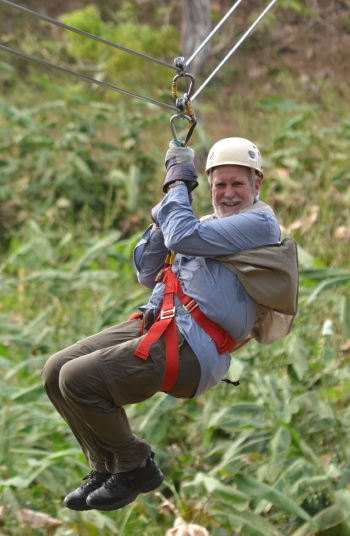
On the zip-line
conquering one’s fears
photo: The Original Canopy Tour
The quick rides themselves were pretty strenuous, but the young men assisting us with our harness and pulleys were so competent that I felt no fear at all. I didn’t always manage to face forward during a traverse, which annoyed me, and a couple of endings were less than graceful, but all in all it was just invigorating exercise, and plain good fun.
There were crocodiles in the river that ran beside the venue – some basking on a sand spit partway across the river, and one big fellow lurking in the water below the embankment where we stood, just watching us – and that was a marvel. Indeed Heather and Werner’s boat ride, whose purpose was to observe wildlife, encountered just one crocodile, while we were treated to at least ten of the beasts. Of course their boat tour did see the monkeys and parrots and all the other creatures (except maybe the big snakes) that I had imagined would be part of my zip line adventure.
Both tours – the zip-lining and the boat tour – had delightful and extremely informative guides, who gave a number of fascinating facts about Costa Rica. The country has no military, for example, only a police force; education is free up to post graduate level, including training for medicine and law; the country has 97% literacy; and medicare includes pharmacy and dental care as well as surgery and internal medicine.
Now, at the end of the day I am exhausted and for a period of time after the zip-lining my legs were rubbery, but all in all it has been a fun, informative, and memorable day.
Friday, December 14, 2012
– at sea
After completing the above last night, I logged on to FaceBook 8 and let it be known that I had gone on a zip-line and lived. I set a link to this page, whereupon many people came by to read the story.
One of them was our daughter, Rachael, who promptly went back to FaceBook and typed, “You need to make that your profile pic... it’s awesome!” Another visitor, Craig Woods, soon seconded the motion. So, I complied, and in due course the above picture became the photo of me that everyone in FaceBook now sees.
The reaction was instant, and hilarious:
| David J. | A great big hairy 3 year old full of glee is what I am looking at yes? |
| Joel Y. | Just zipping through the jungle with a bag of groceries from the local Costa Rican convenience store! 9 |
| Chris J. | ...The Rev. Tarzan donned a helmet and was heard shouting...wheeeeeeeeeeeeeee. |
| Tim P. | Johnny Weismuller has nothing on you! |
| Jim W. | Did you scream the Anglican Call of the Jungle? |
I laughed and laughed, particularly at that notion of an “Anglican” call of the jungle. I wonder what it could be? Psalm 34:20 perhaps? he protects all his bones, not one of them will be broken, to be sung in Anglican chant as one flies through the treetops.
Tonight we will cross the equator. For obscure reasons, Heather and I find it quite exciting to be doing so. The ship’s company also treats it with some importance, for there was a nonsensical ceremony to mark the occasion this morning (a little prematurely, as it turns out, for we don’t actually cross the line until 1:30 AM).
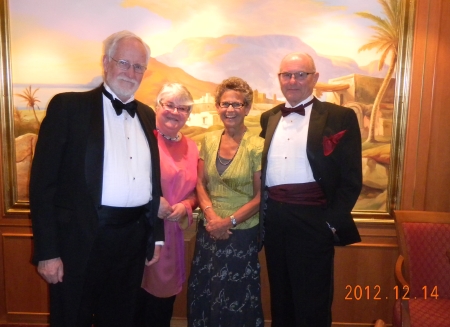
Perhaps in honour of crossing the equator, dining tonight was strictly formal, and the four of us – Heather, Mary, Werner and I – looked very grand as we went down to dinner. Edmundo, whom we have adopted as our personal waiter, took our picture; which is posted here for your admiration.
Our first night on board, we happened to be seated in a particularly quiet area of the dining room, and Werner found it comparatively easy to hear and take part in the conversation. Edmundo, who serves the tables in that section, was so good at his job, and so good-humoured and quick-witted, that we resolved to sit in the same section and at the same table every night, if we could.
We could, and we have done so pretty much every day since. Which is why I say that we “adopted” Edmundo, and his excellent assistant, Farhan.
On our first two dinners, Edmundo had a different assistant: a man from Bali named “Imaid.” While he was not unhandsome, he had protruding earlobes that reminded me of some Indonesian statues of the Buddha. Imaid was, therefore, visually quite memorable. Thus, when he didn’t appear at our third dinner, we missed him immediately. “He has gone home,” said Edmundo.
Why? Was he fired? Was he unhappy and jumped ship? It seemed impolite at the time to ask, but we wondered.
Tonight, the head of all dining services on the ship came by our table and in the manner of bosses everywhere asked if we were finding everything to our satisfaction. He appeared quite willing to stay and converse, so I took the bull by the horns and asked him, “Whatever happened to Imaid, our former assistant waiter?” This senior manager then told us that Imaid had indeed gone home to Bali. However he assured us that the young man had not been fired, nor had he quit. Rather, Imaid had just heard that his nine-month old son was in hospital with some very serious condition, so the Princess organization granted him a leave of absence – whatever time he needed – and had flown him home so that he could be with his family.
We are very impressed. This is a company that knows how to treat its employees.
Most of the staff are third world people, who, in order to improve their families’ circumstances, choose to live and work on these ships far from home for months at a time, even years. For example, Kennedy, our cabin steward, has done so for 14 years, and for him the months of separation are now becoming unbearable. He has just applied to emigrate from the Philippines to Canada, 10 in the hope that he can be at home with his wife and son after work each day. Edmundo, our waiter, is also from the Philippines, and has been separate from wife and children eight months at a time, for twenty years. Unlike Kennedy, he shows no signs of flagging (though he may simply be better at masking his true feelings). The Maitre d’ is from Portugal. He told us that long ago he made a deliberate decision never to marry because of the enforced absences that come with a career in cruising. When his mother died, his ship was in the Mediterranean, and he was able to go home for the funeral quite easily; but when his father died some years later, he happened to be in Australia, and yet the company flew him all the way home (and the family held off the funeral until he could get there). He has now been with Princess for more than thirty years, and has risen to very senior responsibility (in charge of five dining rooms feeding 2,500 people a day). But at what a price!
There are more than a thousand people in similar situations on this ship. Despite this, they all seem to be quite cheerful, and from what we learned from the Maitre d’ tonight, we believe that part of their good cheer can be attributed to excellent staff management on the part of the company.
Monday, December 17, 2012
– at Lima, in Peru
I love being on the sea. I love the motion of the ship and the view of the waves from our comfortable stateroom. Going onshore, however, is another matter.
There is no fancy cruise terminal here at Lima. This is a working commercial port with container ships, and all kinds of trucks and heavy equipment on the pier that would present cruise tourists with some serious hazards, were they to amble about on foot; so we were forbidden to exit the vicinity of the ship on our own. We needed to line up in the baking sun and wait for a minibus to convey us to the port gates, where there would be taxis.
We were heading into Lima with Martin and Joy Freeborn, some people from the U.K. whom we met onboard. Werner and Mary had booked themselves on an official port excursion, but by the time Heather and I looked into doing the same thing, that trip was sold out. Martin, however, is a London taxi driver – he owns and operates his own classic London taxicab – and having done so for over forty years, he and his wife enjoy going on cruises. They are a very friendly couple, and good company, so when they suggested that we make up a foursome to explore Lima on our own, we thought that this would be a good idea.
Working our way through the throngs that were going on tours or trying to get on a port minibus, we eventually found ourselves at something that appeared to be a taxi stand.
Given Martin’s profession, I suggested that perhaps he might be good at negotiating the fare, and he willingly accepted. But I worried a little when the driver that he found spoke almost no English. Given that none of us speak Spanish, I wondered if this guy would understand what we wanted to do.
Using gestures, and simple English, Martin negotiated three hours at $30 U.S. per hour.
Joy, Heather and I then jammed ourselves into the back seat of this fellow’s little Nissan, while Martin sat in the front to give directions.
Ricardo is a natty man – well-pressed shirt, brown leather shoes with pointy toes, a pencil-thin moustache, and thick, black, wavy hair that looks like it would stay in place even in a hurricane. He is not given to smiling. Once, near the end of our three hours with him, he laughed, a harsh laugh, when Martin pointed out the tight-skirted bottom of a young lady at the side of the road.
On the streets of Lima, traffic is scary. Cars zip here and there, and, as Heather likes to say, “making three or four lanes when there should be only two.” Although Ricardo drove with cool precision, never once using the car’s horn, everyone else on the road seemed to delight in honking. Some had installed ear-splitting custom horns in their cars, and used them with abandon. Meanwhile pedestrians, like swarming insects, crossed in front of traffic without warning, a few of them stopping by the car’s window to peddle newspapers, or some unrecognizable artifact.
At first we tried to keep the car’s windows closed, but Ricardo’s air-conditioner was either non-existent or broken, so very soon we rolled down the windows again, and were saying repeated “no, thanks,” to vendors who now had partial access to us. When Martin’s gesticulations in the front seat seemed to be getting nowhere, Heather and I pored through a Spanish phrasebook seeking words for “air conditioning” or “will you wait for us?” or “cathedral.” Sometimes Ricardo would recognize a word that we would read out, and say “Si!” or “Not here. I go there. Dos kilometres.”
Suddenly he pulled into a large garage that I thought might be a carwash. Men with brushes and buckets of soapy water were working on several parked vehicles. Ricardo clearly intended to leave his car there. He gave his keys to the attendant, and proceeded to lead us down the noisy, crowded street.
I later learned that the facility in which he had left the taxi was, in fact, an indoor parking lot, not a carwash. It seems that in the parking lots of Lima, men with buckets offer a handwash service. While we were exploring, Ricardo’s taxi was cleaned.
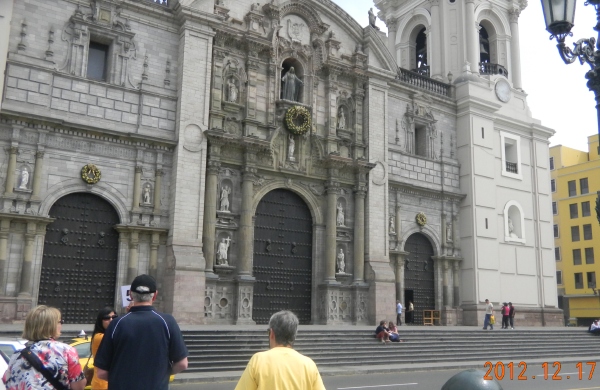
The Cathedral in Plaza de Mayo, Lima, Peru
photo: Werner Schulz
Admission to the Cathedral cost ten solas each, and the ticket-takers would take nothing but this local currency. We only had US dollars, so Ricardo paid, and said that he would simply add that cost to our fare (somehow he successfully communicated this to Martin, who relayed it to the rest of us).
I liked the cathedral. Not for any spiritual reason, mind you – it did not induce in me any sense of the presence of God – but it was quiet, and there were some impressive carvings and works of art.
Probably for me the most memorable thing was a single statue: a tall slim figure in the robes of a bishop, holding a human heart in his upraised hand, and a slippered foot squarely planted on a grimacing, severed human head. Grotesque, disconcerting, and astonishing. Did this bishop actually kill and dismember someone?
I found a cathedral employee who had sufficient English and asked him. He said that the statue was purely symbolic, representing St. Augustine of Tripoli, who eliminated “atheism” in Libya. At least I think that this is what the fellow wanted to tell me. We were communicating after a fashion, but not well. However, even if I did understand it correctly, the statue was still disconcerting. Somehow I cannot accept that any Christian leader should be represented as killing and dismembering a fellow-human, no matter how metaphorical the artist’s intention.
Another notable part of the cathedral was a room full of large paintings... each one depicting a sign of the Zodiac. It was Joy Freeborn who first realized what they were. I had casually glanced at them myself, and they just seemed to depict a series of bucolic scenes, but Joy said, “See? In the clouds near the top of each picture, there is a Zodiac symbol! That one’s a ram, then there’s a bull in the next; over there we have some fish, and here is a scorpion!” Little brass plaques beside each painting nailed the message home: the name of one of the twelve signs graced each plaque.
Hello? The Roman Catholic Church has oft times denounced astrology! How is it that a cathedral can display paintings extolling it?
No one was present who could give me an answer to this question, and I’ll just have to remain ignorant for now.
We spent a fair amount of time in the cathedral while Ricardo waited outside. By the time we reemerged, we were pretty much done with exploring. Had we been able to communicate in detail, perhaps we could have organized a trip on to one of the two famous museums in the city, but I knew that working out such a plan with Ricardo would be totally beyond our limited communication skills, so I let it rest. The others seemed pleased just to ask him to find us a place where we might get some small and necessary sundries before returning to the ship.
We read out some words from Heather’s phrasebook, Ricardo nodded, and then walked off, motioning us to follow. We crossed some streets, taking our lives in our hands despite some police officers loudly blowing whistles in an indeterminate fashion.
In the course of that journey we passed by the enormous courtyard of the presidential palace, where soldiers in gleaming metal helmets could be seen standing on ceremonial guard. Eventually we came to a shop, and Ricardo motioned us to go in. Inside we found nothing familiar. Clerks stood behind counters. There were no aisles of consumer products for us to examine, just the staff and their counters. Eventually I spotted a glass case containing packets that had to be what Heather wanted. I called her over, and soon she was gesticulating to the clerk. An item was located and placed before her on the counter. Payment would be accepted in solas, only.
Once again Ricardo stepped forward, and paid for the items in the local currency. There would obviously be a reckoning back at the ship, and I feared that the exchange rate that he would assess for this service might be quite extreme. But what could we do?
Some of the things we needed were not in this botica, however, so there followed a consult among the four tourists, and Ricardo was then asked to convey us to an actual shopping mall. Martin gets the prize for successfully communicating this requirement to our stone-faced guide. We returned to the car, and off we went. I recognized enough of the route to realize that we were heading towards the pier and the cruise ship.
As with many big cities, the neighbourhood of Lima’s port is pretty sketchy. Paint peels from walls, graffiti adorns fences, and many dwellings are roofless and windowless. 11 Partway through this rough-looking district, Ricardo pulled off the road and entered the parking lot of what turned out to be a sizeable shopping mall. Would we be safe here? He said nothing, but got out of the car and once more led off, with the four of us trailing behind like ducklings.
To my amazement, once we got inside the mall, it turned out to be a seriously upscale shopping centre, with scores of boutiques and specialty stores, and a throng of well-dressed patrons. We followed Ricardo to a hair-dressing salon, where he tried to find out where the items that we wanted would be available. Was he asking about the right thing? Who knew? But Ricardo set off through the mall once more, and we meekly fell in behind him.
Eventually we came to a spacious, modern, and thoroughly North American supermarket, whose name, “Tottus” suggested that they sell everything. And they did.
Soon all of us were satisfied that we had obtained what we were looking for. We got back in the car and returned to the ship.
Now came payment time. Ricardo had agreed on $30 per hour for a three hour excursion. But he had also acted as money-changer on several purchases, so now things might get a bit tricky. And they did. Having left cab negotiations entirely to Martin, I did not note the time that we had set out, but Martin had noted it, and pronounced that we were safely under the three hours.
Ricardo, however, led off by saying that we had been with him four and a half hours, plus he wanted $30 for the parking, $20 for this purchase, and $10 for that, and his numbers quickly mounted higher and higher. Martin just wagged his finger at him, saying, loudly, in English, “No, no, no! We were just three hours with you. No four hours. Three! Three!” (here he held up three fingers inches from Ricardo’s nose). Three hours at $30 meant $90, but Martin and I each produced a $50 dollar bill, and thrust $100 at Ricardo, with Martin saying in a lecturing tone, “Here! One hundred dollars. Ten dollars extra. Very good. One hundred dollars.”
Ricardo took it.
“Now,” said Martin, “we shall see about the other things. First, the cathedral. Thank you for paying. It was ten solas each. That makes four dollars American. Four dollars. Sixteen for four of us. Tony, please give me eight dollars.” “Here,” I said, handing it over. “Sixteen dollars!” repeated Martin, and he pressed that amount into Ricardo’s hand.
And so it went, Martin insisting upon the price for each item that he thought was right, and Ricardo, stone faced, accepting it without further demur.
The experience left me quite unnerved. But as we returned to the ship, Martin the London taxi-driver said, “In London, I would have considered it a good morning if I was paid the equivalent of $30 an hour. Ricardo did not suffer by what we paid him. And I checked with the attendant at the cathedral: if they were to charge admission in U.S. currency, they would ask for $4 per person. Ricardo tried to get $5 out of us. I think he still made a profit at $4. He will go home tonight satisfied, you mark my words.”
And I did mark them. Right here, in this blog.
Next: “Sea legs”... and more
FOOTNOTES:
6 I’ve been told that the average cruise passenger gains two pounds per day while on a cruise! Since this is a thirty day cruise, Heather and I may disembark in Buenos Aires sixty pounds heavier, if we’re not careful!
Click here to get back to the narrative.
7 I imagine that the Puntarenas current is very similar to what the people around Canada’s Bay of Fundy call the “tidal bore.”
Click here to get back to the narrative.
8 I should point out that this is an important reversal. Several times now I have first put my updates on FaceBook, and only later worked such updates into this website (for example, see “A Camping Trip – in Status Updates,” posted October 4 of this year). However in this instance I posted the story here first, and only then told my FaceBook friends about it!
Click here to get back to the narrative.
9 Joel mistook my Tilley vest, which was flapping in the wind due to my speed, for a backpack full of groceries.
Click here to get back to the narrative.
10 As it happens, Kennedy has specifically applied to emigrate to our own city of Winnipeg, and he was very excited to meet us – actual Winnipegers who are, for the moment, “his” passengers! I gave him my card and told him to get in touch with us when he arrives.
Click here to get back to the narrative.
11 We learned from the ship’s “Port Lecturer” a fascinating fact about those unfinished houses: If you build a new home in the district of Callao (Lima’s port) and never put a roof on, your place is considered incomplete, and therefore exempt from property tax. Rain is not very plentiful hereabouts, so there are no unpleasant consequences to this decision. Many people therefore leave things permanently undone, and evade taxes for years. Who knew!? However, it makes for a very unsavoury-looking neighbourhood.
Click here to get back to the narrative.